Our Assessment Process and the Tools We Use
A good assessment should never rest on one questionnaire, one interview, or one impression. It should build a picture carefully, from multiple angles, and hold in mind not only traits, but history, functioning, context, masking, and the wider psychological landscape.
That is why our assessments use a triangulation of data approach throughout. We draw together the clinical interview, structured assessment tools, developmental history, current presentation, functional impact, collateral information where available, and professional clinical interpretation. This helps us build a diagnosis that is thoughtful, balanced, and clinically robust.
We also pay close attention to observation. Assessment is not only about content, in other words, what somebody tells us about themselves. It is also about process: how the person communicates, how they use eye contact, how they relate interpersonally, how easily conversation flows, how they describe internal states, and what patterns emerge in the room over time. We therefore observe interpersonal style, eye contact, communication patterns, reciprocity, emotional expression, and the overall quality of interaction, while recognising that all of these may be shaped by masking, anxiety, trauma, and context. This is particularly important in women and high-maskers, where surface presentation may not reflect the amount of effort, compensation, or distress happening underneath.
Where possible, informant information is always preferable, as it strengthens the developmental picture and offers another perspective on longstanding patterns across settings. However, we understand that this is not always available. Some adults may be estranged from family, may not have someone appropriate to ask, or may not have an informant who knew them well in earlier life. Assessment can still proceed without collateral, but we would discuss this openly and consider how best to strengthen the overall formulation with the information available.
What do DSM-5 and ICD-11 mean?
DSM-5 stands for the Diagnostic and Statistical Manual of Mental Disorders, Fifth Edition. It is a diagnostic framework produced by the American Psychiatric Association and sets out the symptom criteria clinicians use to determine whether someone meets diagnostic criteria for a particular mental health or neurodevelopmental condition. ICD-11 stands for the International Classification of Diseases, Eleventh Revision. It is produced by the World Health Organisation and is the broader international system used across health services to classify and code health conditions, including mental and neurodevelopmental conditions.
Why do we map diagnoses to DSM-5 criteria?
Although ICD-11 is an important international framework, many of the structured neurodevelopmental tools that are considered 'gold standard' and are commonly used in practice were designed around DSM-style symptom structures and thresholds. For that reason, mapping diagnoses to DSM-5 criteria often provides the clearest and most methodologically consistent way of integrating the tools we use into a coherent formulation. This is not because ICD-11 is unimportant, but because several of the interviews and measures used in neurodevelopmental assessment align more directly with DSM-5 symptom mapping. In practice, this makes the diagnostic process clearer, more transparent, and more internally consistent.
ADHD Assessment Process
Our ADHD assessments are designed to explore whether longstanding patterns of inattention, impulsivity, hyperactivity, internal restlessness, executive functioning difficulty, and emotional regulation challenges are consistent with ADHD, and whether these patterns are causing meaningful impairment in everyday life.
The process begins with a detailed clinical interview, usually lasting around one and a half to two hours. We explore developmental history, schooling, relationships, work, home life, coping strategies, emotional regulation, and the day-to-day reality of how attention and executive functioning are affecting life now.
A central structured element of the ADHD assessment is the DIVA-5, which stands for the Diagnostic Interview for ADHD in Adults, Fifth Edition (Kooij, Francken, & Bron, 2019). or the Young DIVA for children. This is a clinician-administered structured diagnostic interview based on DSM-5 criteria. It is designed to assess ADHD symptoms across both childhood and adulthood, alongside the chronicity of symptoms and the degree of functional impairment. In other words, it helps us look not only at whether ADHD traits are present, but whether they have been longstanding, clinically significant, and evident across different stages of life. We consider hormones and co-morbid physical conditions that often occur alongside ADHD.
In ADHD assessments, we also collect collateral information wherever possible. This helps us understand how attention, impulsivity, restlessness, organisation, and functional difficulties have presented across time and in different settings, rather than relying on self-report alone. For adults, this may include a partner, parent, sibling, or another person who knows them well. For children, this would usually include parents or carers and, with consent, relevant school information. Although this is preferable and strengthens the developmental picture, assessment can still proceed without an informant if necessary, and this would be discussed openly as part of the process.
Alongside this, we use carefully selected questionnaires and rating scales to explore functional impact and related difficulties. We are interested not only in whether ADHD traits are present, but in how they have been managed, masked, misunderstood, or compensated for over time.
Autism Assessment Process
Our autism assessments are designed to explore longstanding differences in social communication, sensory processing, flexibility, interoceptive awareness, emotional expression, empathy style, relational patterns, masking, and the ways a person experiences and navigates the world.
The process again begins with a detailed clinical interview. We look closely at developmental history, friendships and relationships, sensory profile, communication style, routines, focused interests, patterns of overload or shutdown, and the inner effort involved in social and daily functioning. We are especially mindful that autism, particularly in women and high-maskers, may not present in stereotypical ways. This is why we do not rely on surface presentation alone.
In the autism assessment, we may use a number of structured tools depending on the individual presentation.
One of these is the MIGDAS-2, or Monteiro Interview Guidelines for Diagnosing the Autism Spectrum, Second Edition (Monteiro & Stegall, 2018). This is a sensory-based, qualitative assessment framework that helps organise the information needed for autism diagnosis while allowing for a more individualised exploration of the person’s internal experience, sensory world, and preferred ways of engaging.
We also use the ADI-R, which stands for the Autism Diagnostic Interview – Revised (Le Couteur, Lord, & Rutter, 2003). This is a structured developmental interview, usually used where there is someone available who can give detailed early developmental history. It is particularly helpful for understanding childhood presentation and distinguishing autism from other developmental or psychological patterns.
Another tool we use is the ACIA, the Autism Clinical Interview for Adults (Wigham, Ingham, Le Couteur, Berney, Ensum, & Parr, 2020). This is a semistructured interview developed specifically for adult autism assessment and designed to support DSM-5-aligned adult diagnostic work.
Where observation is clinically useful, especially in telehealth or remote settings, we use the BOSA, the Brief Observation of Symptoms of Autism (Dow, Holbrook, Kim, & Lord, 2021). This is a brief observational framework developed from ADOS-2 methods. The ADOS-2, or Autism Diagnostic Observation Schedule, Second Edition (Lord et al., 2012), is one of the best-known observational autism assessment tools, and the BOSA was developed as a more flexible observational format that can be used live, by telehealth, or from recorded interaction where appropriate.
We also look carefully at masking, interoceptive ability, and empathy. These areas matter because many autistic women have learned to camouflage their traits, may have a complex relationship with bodily cues and internal awareness, and may experience empathy in ways that are often misunderstood by older stereotypes. A careful assessment therefore asks not only whether someone appears socially able, but what that social ability costs, how it is achieved, and whether it feels natural or effortful.
AuDHD Assessment Process
Our AuDHD assessments are designed for people whose presentation suggests meaningful traits of both ADHD and autism, especially where the two may overlap, obscure one another, or create an experience that feels internally contradictory.
This is not simply an ADHD assessment plus an autism assessment placed side by side. It is a careful exploration of how both profiles may coexist within one person and shape each other. We explore attention, executive functioning, impulsivity, sensory experiences, communication style, social fatigue, emotional regulation, masking, shutdown, burnout, routines, novelty-seeking, and the often conflicting needs that arise when both ADHD and autism are present.
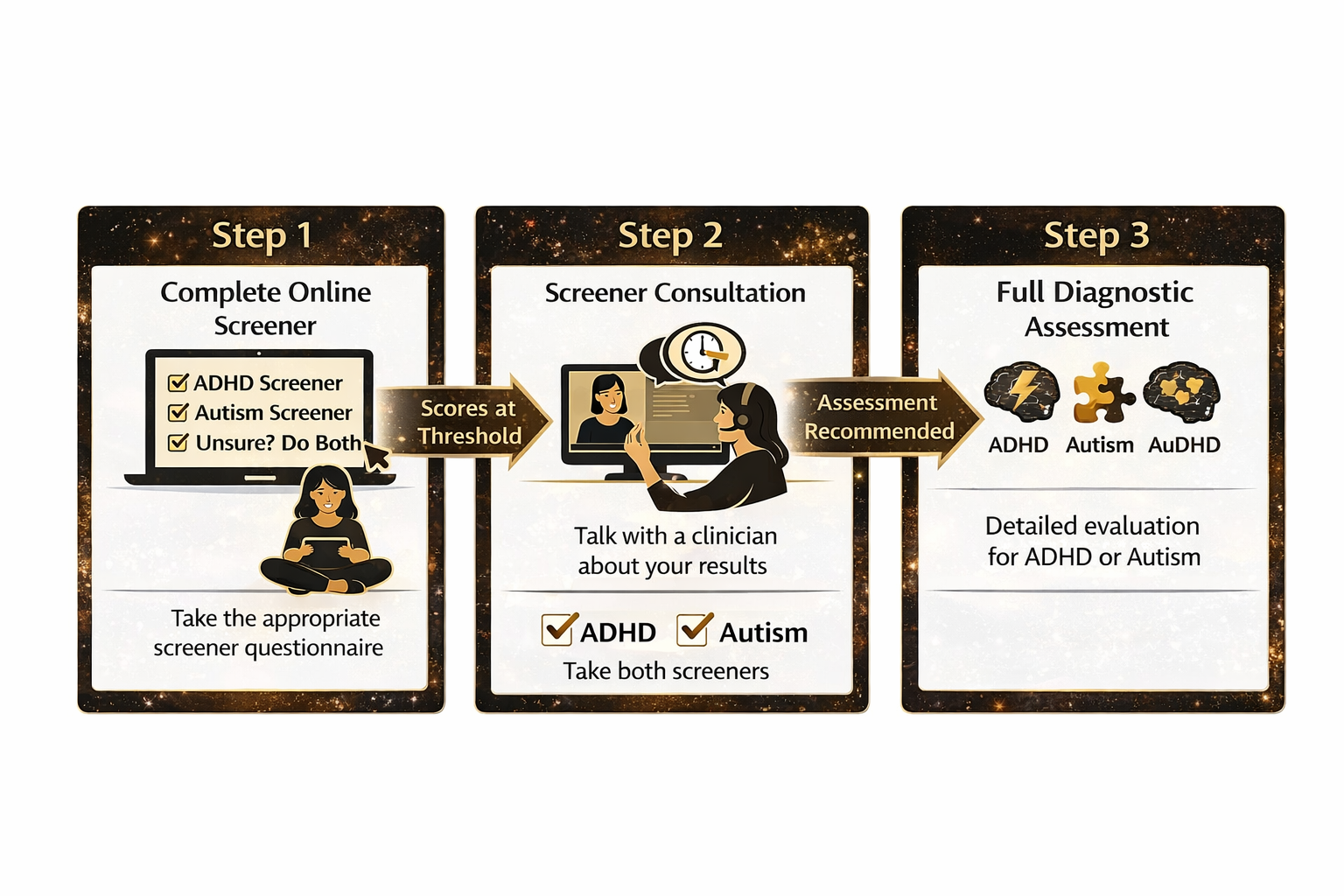
In these cases, we draw on tools from both pathways, including the DIVA-5, the structured ADHD diagnostic interview, alongside autism-specific interviews or observation frameworks such as the MIGDAS-2, ADI-R, ACIA, and where appropriate the BOSA. The exact combination depends on the individual presentation. This is one of the reasons the screener and consultation stage matters so much. If additional information emerges early on, we may adapt the assessment plan so that it better reflects the person’s actual profile rather than forcing them through a fixed route.
Differential Diagnosis and the Wider Psychological Picture
All of our assessments consider relevant differential diagnoses carefully. In ADHD assessments, we remain alert to autistic traits where sensory issues, social fatigue, rigidity, masking, or shutdown patterns suggest autism may also be relevant. In autism assessments, we consider ADHD where there are longstanding difficulties with impulsivity, executive functioning, attention regulation, urgency, or internal restlessness. In AuDHD assessments, this cross-consideration is built into the process from the start.
We also consider trauma and attachment very specifically. This is important because trauma can affect concentration, emotional regulation, sensory tolerance, trust, safety, and day-to-day functioning in ways that can overlap with or intensify neurodivergent traits. Attachment difficulties can shape relational patterns, emotional responses, coping strategies, and self-concept. At the same time, neurodivergence and trauma can coexist, and many neurodivergent people have developed attachment wounds or trauma responses precisely because their differences were misunderstood, unsupported, or repeatedly invalidated. Our aim is therefore not to force a simple either-or explanation, but to understand the full picture as accurately and compassionately as possible.